AI in Information Professions
AI as Library Practice
AI contributes to core library and information tasks, including:
- Linked data for metadata and knowledge organization:
- linked data work by OCLC (OCLC Linked Data)
- Search and discovery systems:
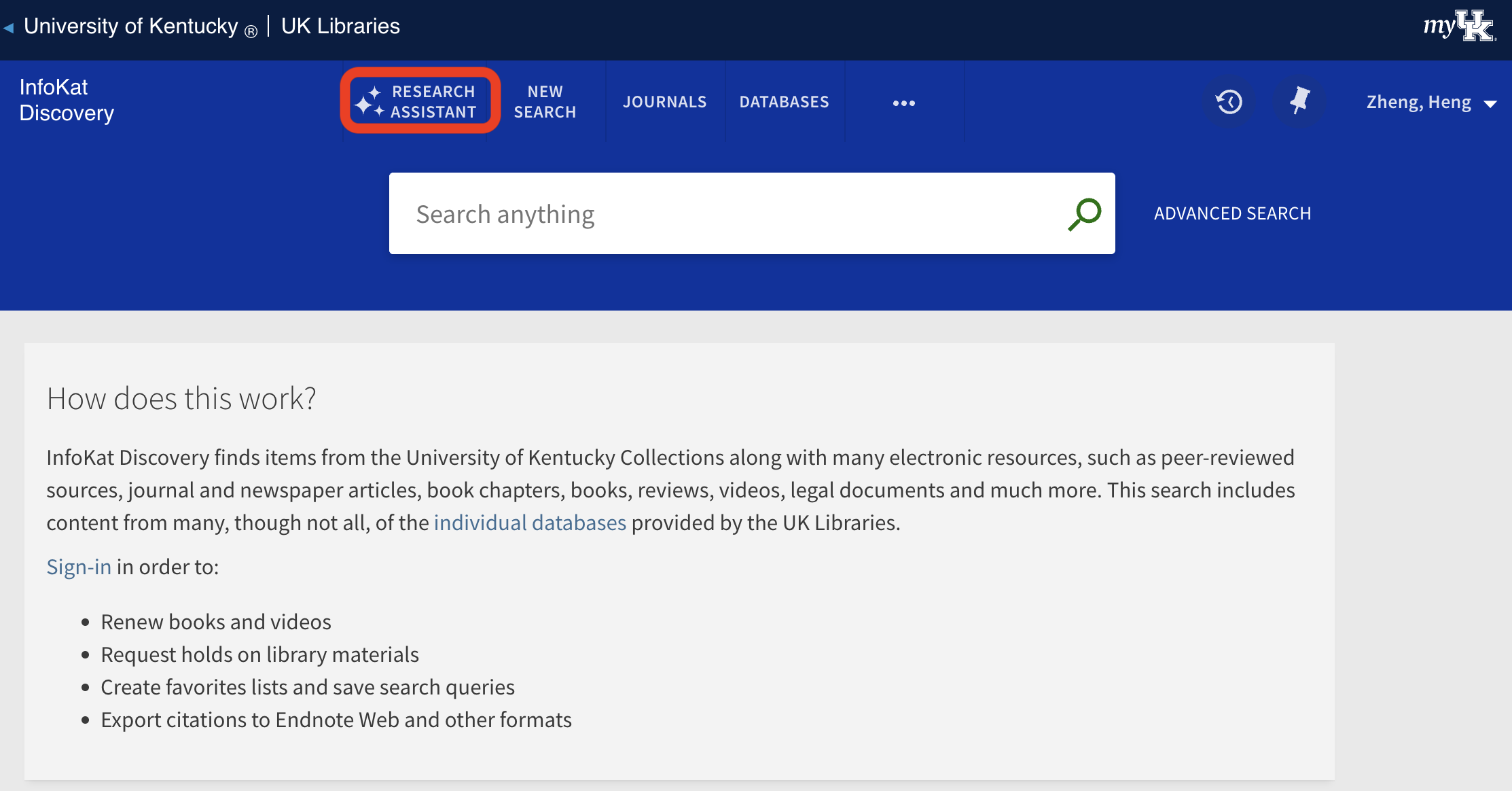
- Ex Libris Primo with the Research Assistant feature.
- Campus-wide example: University of Kentucky InfoKat Discovery with Research Assistant enabled.
Other examples and resources
The following resources provide examples of how AI is being explored and applied in library contexts.
-
Institutional guidance and practice:
- University of Kentucky Libraries resources on generative AI use
- University of North Carolina Libraries guidance on generative AI and libraries
-
Professional perspectives on AI in public libraries:
AI as Information System Infrastructure
AI functions as core infrastructure within many information systems. In organizational settings, AI is widely used in the following areas:
-
AI interface for internal information systems
- Example: Microsoft 365 Copilot for organizations, used by many institutions, including campus-wide deployment at the University of Kentucky (see UK's AI offerings)
- Enterprise-level AI assistants often include data protection and privacy safeguards. For example, enterprise data protection in Microsoft Copilot
-
Customer support and service automation
- Overview: Automating call centers with AI
- Example: Salesforce Agentforce AI agents (Agentforce AI agents)
-
AI introduces new challenges for cybersecurity: