What Is Artificial Intelligence?
Defining artificial intelligence (AI) is not straightforward. AI is a rapidly evolving field, and definitions that were common in the 1990s may no longer fully apply in the 21st century. As noted in one of the most authoritative textbooks in the field, Artificial Intelligence: A Modern Approach by Peter Norvig and Stuart J. Russell, AI systems were previously understood as optimizing a predefined utility function supplied by their human designers. In more recent formulations, this assumption is relaxed: an AI system does not necessarily know the exact objectives it is meant to pursue. Instead, it may be uncertain about human goals and must learn what to optimize, while still behaving in an appropriate and responsible manner despite this uncertainty.
I view AI as the practice of endowing machines with intelligence. However, what counts as “intelligence” itself remains a subject of ongoing debate in academia and is often intertwined with philosophical discussions. This lack of consensus helps explain why some researchers predict that artificial general intelligence (AGI) may arrive within a few years, while others argue that AGI is still a distant prospect.
Early definitions of AI can be traced back to the 1950s. In his paper “Computing Machinery and Intelligence,” Alan Turing proposed the question, “Can machines think?” Turing also introduced what later became known as the Turing Test, originally called the imitation game. Under this framework, a machine can be said to exhibit intelligence if its conversational behavior is indistinguishable from that of a human, as judged by a human interrogator under controlled conditions. A 2025 study has claimed that large language models have passed the Turing Test, but this claim has also been challenged. These debates raise a fundamental question: does imitation alone constitute intelligence? If a machine can imitate human behavior, does that mean it truly understands humans?
Other influential definitions of AI include that of John McCarthy, one of the pioneers of the field, who answered the question “What is AI?” by stating: “It is the science and engineering of making intelligent machines, especially intelligent computer programs. It is related to the similar task of using computers to understand human intelligence, but AI does not have to confine itself to methods that are biologically observable.”
Another widely cited definition comes from Artificial Intelligence: A Modern Approach, which defines AI as “the study of agents that receive percepts from the environment and perform actions.”
In public discourse, AI is often conflated with machine learning (ML). From the perspective of many AI researchers, however, ML is not equivalent to AI; rather, it is a subfield within AI. By the same logic, neural networks, deep learning, and even large language models are all sub-concepts within the broader domain of AI.
Also see the following talk from Mustafa Suleyman, current Microsoft AI CEO, for his opinions on what AI is:
AI Literacy
AI literacy can be interpreted through the framework developed by Dr. Kara Kennedy.
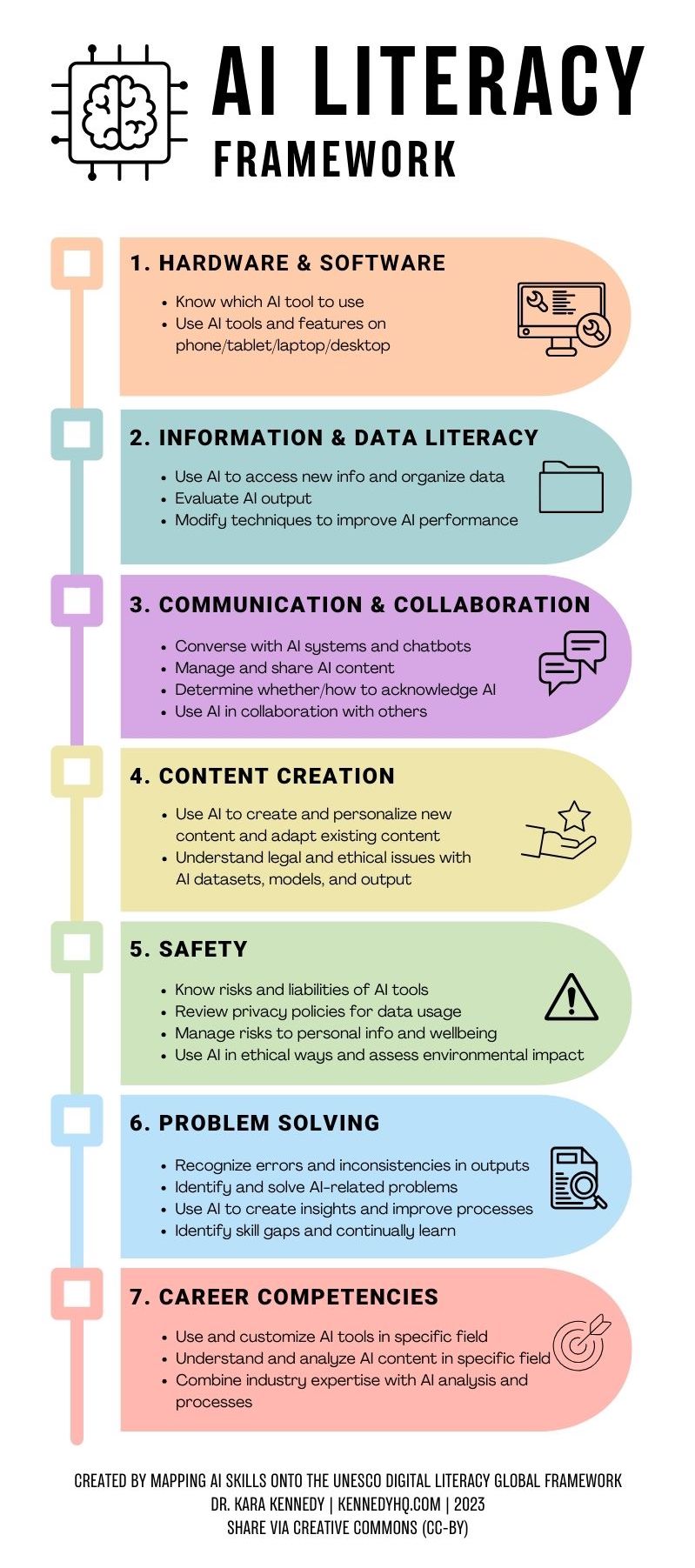
Image source
Key References and Organizations in Artificial Intelligence
Artificial Intelligence: A Modern Approach Stuart Russell & Peter Norvig
Often regarded as the most influential textbook in artificial intelligence, AIMA provides a comprehensive overview of core AI concepts, paradigms, and methods. It is the authoritative, most-used AI textbook, adopted by over 1500 schools.
Major AI Organizations and Research Communities
-
Association for the Advancement of Artificial Intelligence (AAAI) A premier scientific society in AI. AAAI organizes the annual AAAI Conference on Artificial Intelligence.
-
International Joint Conference on Artificial Intelligence (IJCAI) A non-profit organization (founded in 1969) that runs IJCAI conferences. IJCAI conferences are premier international gatherings of AI researchers and practitioners.
-
Association for Computing Machinery (ACM) The world’s largest educational and scientific computing society. ACM provides the ACM Digital Library and supports publications and conferences.
-
Institute of Electrical and Electronics Engineers (IEEE) The world’s largest technical professional organization, advancing technology for the benefit of humanity through publications, conferences, and standards.